Saturday, December 20, 2014

Are we really listening?

Everett Bowes, Director of Brandstory at VCI-SF recently posted something on LinkedIn that was good enough that I wanted to pass it along, although from a slightly different perspective than he presented;

In English, like some other languages, we write our words phonetically: that means we place letters beside other letters, each having their own “sound”. The combination of these sounds forms words.

The Chinese writing system is different. Instead of constructing words by combining “sounds”, they build words by combining symbols, or characters. Each character represents an entire word.

There's a lesson from breaking down the Chinese word “To Listen” into its four individual symbols:


EARS: This is the most obvious aspect of listening, but it is the least important part of truly hearing.

Researchers measured heart rate, perspiration, respiration and other biometrics of people digging a ditch. They also measured the same biometrics for people engaged in active listening and they found that active listening has a similar effect on our bodies as digging the ditch!

That’s why we feel “wiped out” after a day of meetings, or conferences; it feels as if we have been digging a ditch for eight hours.

Active listening is hard, and takes effort. This Chinese symbols which make up the word remind us that there is more to active listening than simply lending an ear.


EYES: Most of us can recall moments when our parents said, “look at me when I’m talking to you.” As an adolescent we responded defiantly, saying, “I am listening”, while we diverted our eyes elsewhere. Now that we are parents we understand this better: when they are not looking, they are not listening.

Though it’s common to think that we listen with our ears, eye contact is a key indicator people look for when determining if someone is really listening.

Yet, consider how many times we participate in (one-on-one, or in groups), where eye contact is not established. Often eyes are glued to laptop screens, tablets, presentations, charts, handouts, etc.

Listening with our eyes is not always about establishing eye contact; if someone is using a chart, video, or other visual aid, it is easy to gauge how well the group is listening by how much they are visually engaged with what they are showing.


HEART: Most of us have done this; Someone is talking, and they say, “you’re not listening to me.” We quickly repeat back the last sentence they said, because that shows we were listening, right?

Maybe not. You may have “heard” them with your ears, but not with your heart.

Simply repeating someone's last statement verbatim isn't “listening”.

The Chinese word “to listen” challenges us to listen more deeply. When we “listen with our heart” our faces react differently to the words we hear. Much of our communication is non-verbal, so when someone is talking, and we are listening with our heart, it is reflected on our faces in the form of subtle expressions. A tiny squint, a wrinkle around the lips, a slight change in the brow… these are micro-reactions in our face that result from truly listening with our heart.

People don’t commit to something because their ideas are adopted. They are loyal because they feel heard.

Even if there’s a chance that nothing will be done about what was said, there is intense satisfaction that results from just being listened to. People will endure extremely difficult situations if they feel that their voice is heard.


Undivided Attention: In our fast-paced, digital age, many pride themselves in multitasking. It’s one of the top bullet points on most resumes today. Here’s the sad reality: Studies show people are not as productive while multitasking as they may think. When it comes to feeling heard, no one wants to talk to a “multitasker”.

Focus is a value rapidly gaining importance over multitasking.

Although we have clients, projects, tasks, deliverables and duties enough to more than fill our days, the ability to focus intensely on one point at a time, even if only for a short time, can be the difference between being truly effective and just getting by.

The details swarming our lives can be overwhelming. While they need to be addressed, pressing “pause” on all but one of them them for a time, so we can focus intensely on it, is key to doing amazing work.

Active listening can have a transformational effect on all our relationships; business, families and friends.

If you'd like to see the original article in its business context, click here.

Tuesday, October 28, 2014

The Fundamental Nature of Problem Solving

Wisdom Seeker from halfsatori.com
One morning, exactly at sunrise, a Buddhist monk began to climb a tall mountain. The narrow path, no more than a foot or two wide, spiraled around the mountain to a glittering temple at the summit. - The monk ascended the path at varying rates of speed, stopping many times along the way to rest and to eat the dried fruit he carried with him. He reached the temple shortly before sunset. After several days of fasting and meditation, he began his journey back along the same path, starting at sunrise and again walking at variable speeds with many pauses along the way. His average speed descending was, of course, greater than his average climbing speed.  (Source; Scientific American Magazine - June 1961)

One of the exercises we do in the Design Thinking workshops is a story problem which involves a monk who takes a journey up and down a mountain. The problem is to prove that there is one point on the mountain which the monk passes at the same time of day during the ascending and descending trips. For most people, solving the problem is very difficult because they don't choose to reframe the problem visually. They apply the tools of logic which they have been taught in school and attempt to deduce an answer numerically, based on time and distance traveled.

There is a "mathematical" method to solve the problem, using a graph, which Nathaniel Highstein illustrated on his Reflections on Teaching blog. He states:

"I love this problem because the answer becomes totally clear when you make a time vs. elevation graph – and the answer violates nearly everyone’s expectations and leads to a surprise!"
Time-Position Graph

I love this problem because solving it requires reframing; Making a word problem into a picture problem. This illustrates how different thinking styles are applicable to different types of problems. Another way to solve it is to break a conceptual block and imagine the monk doing the journeys up and down simultaneously. They will meet themselves somewhere on the mountain.

Murai Hodaka meets herself.
In many cases a "problem" exists precisely because there are ambiguities and unknowns. Much of what we are taught about problem solving relates to "finding the unknown" or "solving for x". The real challenges start when the equations are non-linear, the answers are imaginary numbers or there a many inter-related variables. In other words; when the behavior of the system is un-predictable.

There is another aspect to this problem solving thing. It is a skill, which can be learned and therefore taught. Much of teaching these days is concerned with finding effective ways to teach problem solving skills - so that students can discover the answers for themselves.  The body of material on this is huge and growing daily. What is even more interesting are the parallels between the methods of Design Thinking and Problem Based Learning. This discovery is partially what led me to begin to think of Design Thinking as a method of learning rather than a method of problem solving. If you already knew everything you needed to know to solve the problem, it wouldn't be a problem, would it?

It's also why Design Thinking involves brilliant detective work and a lot of background knowledge.

The game's afoot!
(From Dee Garretson's Historical Mysteries and Romantic Suspense blog)


Monday, October 20, 2014

A tribute to John Marshall

Recently, I was involved in a somewhat philosophical conversation about the relationship between Product and Industrial Design, specifically regarding why one typically resides in schools of Engineering and the other schools of Art and was reminded of John Marshall, who passed away several years ago after a very difficult battle with cancer.

John was a remarkable individual; Genuine, authentic, passionate and extremely talented. He founded the Industrial Design program at BYU in 1967 and taught there for 41 years, first in the Art Department, and then in the College of Engineering when the program was moved there.  He also taught design in Hong Kong, Israel and Switzerland and practiced it at Hewlett Packard.  What many may not realize is how ubiquitous his work was in electrical engineering circles.

Growing up and working in Palo Alto, I was unknowingly exposed to John's work very early, both when I worked in HP's Prototype Model Shop at the Stanford Park Division and at the Stanford Linear Accelerator Center, who's labs were stuffed full of HP test gear.

Here are a couple of samples of John's HP product renderings;

Signal Generator
Oscilloscope
Compare these with some actual HP test gear and the family resemblances are striking.

HP 8656A
HP 8570A
John insisted that his students learned and understood the inseparable connection between form and function. He also knew that the tools of engineering could also be forms of art.

Lest anyone think John was only about circles and rectangles, he also did landscapes, cars and the occasional chicken;


His influence and passion are deeply missed. I regret not having gotten to know him better.

As a further tribute to John's vision and passion for good design; Back in 2011 Ziba's Industrial Design Director, Paul Backett published an article in Core77 entitled Designing the Ideal Industrial Design Program wherein he wrote of BYU's Industrial Design program;

"Less well-known than many American design programs, BYU continually impresses with solid, unflashy but well-considered design work that solves real problems and addresses human needs.

The school is distinguished by a remarkably passionate teaching staff who instill that passion in their students. They also inspire an incredible level of user empathy; students here, more than almost any other school, are clearly not designing for themselves. 

The BYU work ethic is one of the strongest I've encountered, with students tenacious enough to make short work of obstacles that would completely frustrate the typical ID grad."

It was interesting to note that of the seven ID schools Backett mentioned, only two; BYU and the University of Cincinnati, were in the United States. High praise indeed.

BYU XVW
This year (2014) year also marks the tenth anniversary of the XVW. In 2004, a team of BYU Industrial Design Students completed a fully functional sports car, built from the ground up, and unveiled it to representatives from General Motors and Ford.  Resembling a Corvette convertible and featuring a Volkswagen engine, the car was designed and constructed by three groups of Industrial Design Program seniors over a period of more than two years.

Advised by John Marshall, a team of 16 students built the one-of-a-kind automobile as part of a senior design class. The project exposed them to the varied phases of automobile development.  They learned how to design better vehicles because of the perspectives they gained, and fostered relationships between BYU and the auto industry.

2004’s group of industrial design students included Brian Sanderson, Jason Tippetts, Cameron Bigler, Trent Fulkerson, Ryan Dart, Matthew Pectol, David Haskell and Todd Taylor.

A former student said that John; "Always made me feel like I could design anything and....do a good job."

Saturday, October 18, 2014

Bridgebuilding


Recently I've been working closely with a team of very bright and enthusiastic students who are trying to solve a wicked problem for a local business. Of course, I've been encouraging them to use Design Thinking methods to enhance their chances of success. This week they had their first opportunity to share their results with another student team who are working on another, much more highly defined, problem. The interaction was really interesting.

Since their problem was already fairly narrowly defined, the students with the "constrained" design challenge had jumped right into rapid prototyping and had already built several quick models.  The "wicked" team had interviewed over a dozen people involved in nearly every aspect of their design challenge and uncovered a whole suite of relevant issues.  Both teams had been productive and done some great initial work. Yet, when it came time to return and report concerning their efforts, there was a huge difference in the content of their presentations.

When the Q&A period began, the only two questions which the members of the "constrained" team had for the "wicked" team were; "What are you doing?" and "Do you have a schedule yet?" It was difficult not to value the "reality" of their physical prototypes more than the results of the empathy mapping.

This morning I received a message from a fellow Design Thinker which contained a story with a similar theme. He had used the terms Human Centered Design and Design Thinking with one of his more traditionally grounded clients and they had expressed some apprehension about it.

I've blogged before about the importance of taking on the mindset of the customer when talking about, or doing, Design Thinking. These two examples shed some light on the reason for my belief.

Since DT is a radically collaborative activity, it's very important that everyone have a flexible and expandable knowledge framework. Moreover, since DT operates at the intersection of Humanity, Technology and Business, it's at least triply important that there be a common framework for the conversation. That can be very difficult when even the definition of the process varies. With Design Thinking part of the challenge is that neither the elements nor the terminology are really new, yet it often presented as something new. In that regard, it's a bit like old wine in a new bottle.

Continuing with the wine analogy a bit further; Teaching or discussing Design Thinking suffers from the same old wine in a new bottle problem; If you simply changed the label, how does a neophyte recognize the vintage and vintner before removing the cork or taking a sip? How do they know if the contents are Domaine Romanée-Conti or Lucky Vin Rose?
Recently, I've begun to think of DT as not only a proven method of enhancing creativity, but an approach for identifying and learning what is and isn't relevant in solving complex, interrelated, multi-dimentional problems.

I'm not sure exactly how to get there just yet. I also don't know if its necessary to be an "artistic engineer with an MBA" to be able to effectively bridge the conceptual and conversational gaps between the camps. It may be that all we need is some sort of tri-lingual dictionary.

Is it time for Design Thinking for Dummies?

Tuesday, September 16, 2014

Interviewing with Empathy

Interviewing with Empathy can be one of the more challenging Design Thinking skills to learn. One method is to observe someone else who knows how to do it, but I recently came across the web page of an organization that appears to have been polishing their empathic listening skills since the 1960's.

The Center for Nonviolent Communication emerged from work done by Marshall Rosenberg with civil rights activists, mediating between rioting students and college administrators and working to peacefully desegregate public schools.

There are four core principles in NVC;
  • Observation: Observing  of things which are seen, heard, or touched, without evaluation of their meaning or significance, and with a focus on specific to time and context.
  • Feelings are viewed as an indicator of whether we are experiencing our needs as met or unmet.  Identification of feelings is said to allow us to more easily connect with one another by allowing ourselves to be vulnerable and helping resolve conflicts.
  • Needs: Universal human needs, as distinct from particular strategies for meeting needs. NVC states; "Everything we do is in service of... needs."
  • Requests are distinguished from demands in that one is open to a response of "no" without attempting to force the matter.  A "no" should also not lead to giving up. Solutions are found by empathically understanding what is preventing the other person from saying "yes." Requests should be stated in clear, positive, concrete action oriented terms. 
The core model of NVC represents two sides of an empathic conversation:
Empathetically Listening:
Observations
Feelings
Needs
Requests
Honestly Expressing:
Observations
Feelings
Needs
Requests
NVC is self-described as;

"With NVC we learn to hear our own deeper needs and those of others, and to identify and clearly articulate what “is alive in us”. When we focus on clarifying what is being observed, felt, needed, and wanted, rather than on diagnosing and judging, we discover the depth of our own compassion. Through its emphasis on deep listening—to ourselves as well as others—NVC fosters respect, attentiveness and empathy, and engenders a mutual desire to give from the heart. The form is simple, yet powerfully transformative."

Three unique tools of NVC are their Universal List of Feelings and associated lists of Satisfied and Unsatisfied Needs, which could be useful for developing the empathy maps of Design Thinking.

Some Useful Tips


Establish trust with participants
Create an atmosphere in which people feel comfortable enough to open up. 
  • Listen patiently. 
  • Do not interrupt. 
  • Allow for pauses. 
  • Give participants time to think. 
  • Use non-verbal gestures, such as eye contact, nodding, and smiling, to reassure participants you are engaged and interested in what they are saying. 

Get the most out of your interactions 
Encourage people to reveal what really matters to them. 
  • Ask participants to show you the object or space they are talking about, 
  • Have participants draw what they are talking about. 
  • Keep asking “Why?”, particularly in response to consecutive answers. 

Be on the lookout for;
Actions and statements which reveal what people care about. 
Keep in mind that they may contradict themselves!
  • Look for cues in the things that people surround themselves with or the way they carry themselves.
  • Notice any workarounds and adaptations people have done to make a system or tool serve their needs better, for example: Lowering the height of bulletin boards to make it easier for children to read them.
  • Explore things that prompt certain behaviors, for example: a line around a track field that causes people to run within a certain area.

Capture what you see
Take lots of notes and photos of what you see, hear, feel, smell and taste during a field visit. 

  • Capture direct quotes. 
  • Write down your immediate thoughts without worrying about an interpretation.
Here is an interesting graphic from ComLab India which illustrates how active empathic listening implies being aware of a blend of communication elements;


Tuesday, September 9, 2014

Why Deep Innovation Can Be So Hard

In an article published in Forbes on August 4th, 2014, Edward Hess of the Batten Institute at the University of Virginia's Darden School of Business asked the question "Why Is Innovation So Hard?" In it, he makes several comments about innovation, ranging from the difficulty in defining it to some reasons for its rarity. Hess then makes some observations about humans, emotions and failure, mentioning our biases, need for self affirmation, how we act when we feel threatened, and the ways that hinders innovation.  (I've summarized them at the bottom of this post. - df)

Hess concludes that that innovation requires an organizational environment that encourages failures and mistakes and uses IDEO, Pixar and Intuit as examples. Then he makes two very interesting statements concerning IDEO and Intuit;

"IDEO takes it even further, characterizing failure as good because it helps people develop the humility that is necessary for empathy—a critical skill in user-centric innovation."

"Intuit spent the past eight years building a culture to better foster experimentation-driven innovation. Humility, empathy, and the devaluation of hierarchical rank were critical to making this new culture work."

In the closing paragraph Ed states: "Creating a “big new” or a “big different” for your business requires innovative thinking, and innovative thinking requires the right kind of organizational environment. That is why innovation is so hard."  But, Ed stops short of explicitly stating what kind of environment that is.

If you wrap back in the observations about IDEO and Intuit, the recipe for creativity looks like this:

Creating an innovative environment for your business requires an organization built on humility, empathy, and the devaluation of hierarchical rank.


By the way, this same message is a key element in Ed Catmull's recent book; Creativity, Inc. - Overcoming the Unseen Forces that Stand in the Way of True Inspiration.

Just to be clear on what we're talking about here;

"Humility is variously seen as the act or posture of lowering oneself in relation to others, or conversely, having a clear perspective, and therefore respect, for one's place in context. Humility, in various interpretations, is widely seen as a virtue in many religious and philosophical traditions, often in contrast to narcissism, hubris and other forms of pride." - Wikipedia

Blending a twist onto C.S. Lewis;  A key component of successful creativity is thinking of your customers more than yourself.

Summary of Ed's talking points from the article:

* Hard to define because it means different things to different people. 
* Exists along a continuum, from incremental improvements to disruptive innovation. 
* Occurs "through an inefficient process of ideation, exploration, and experimentation."
* Usually arises from thinking differently than we normally think.
* Arises from learning.
* Neither innovative nor critical thinking come naturally to most people.
* Innovative ideas rarely emerge from an “aha!” moment.
* Innovation requires the willingness to fail and learn.

* People have cognitive biases
* People seek to affirm their self-image.
* People tend to rationalize information that contradicts their beliefs.
* When they feel threatened, people defend themselves and their views.

* Emotions influence and are integrally intertwined in our cognitive processing.
* Fear of failure, looking bad, or losing our job hinders the process of innovation.
* Failure is an unavoidable part of innovation experimentation.

Thursday, September 4, 2014

"Vat are you sinking?"

Is this it?

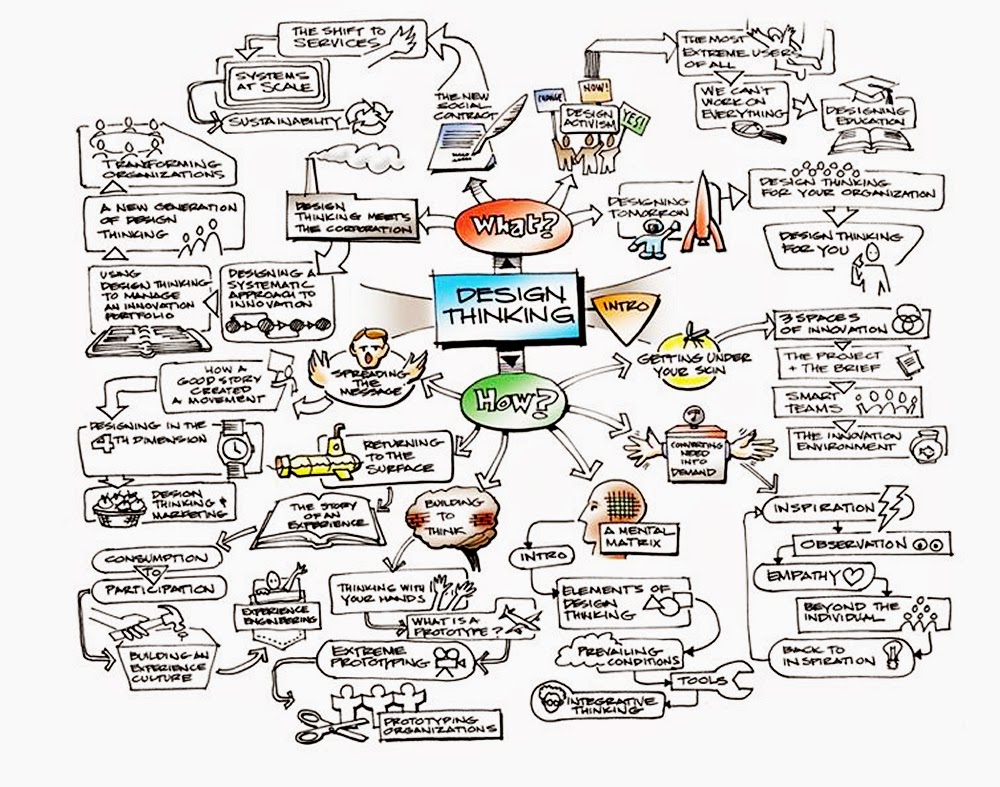
One of the questions that frequently comes up in the eSphere is "What is Design Thinking?" Is it a method? Is it a Mindset? Are there rules? Why does it seem to vary from situation to situation?  I'd like to share a couple of ideas about that in this posting.

How about this?
In order to have any sort of understandable conversation about something, it's a good idea to be speaking the same language. Beyond that, it helps to have an agreement regarding the meaning of words, particularly when the word can serve as both a noun and a verb. Such is the case with the words Design and Thinking;

Wait... maybe this one!
Design as a noun is defined as; A plan or drawing, produced to show the look and function or workings of a building, garment, or other object, before it is built or made. Some synonyms for Design include: plan, blueprint, drawing, sketch, outline, map, plot, diagram, draft, representation, scheme, and model.

Used as a verb, Design is defined as; To decide upon the look and functioning of (a building, garment, or other object), typically by making a detailed drawing of it - or - To do or plan (something) with a specific purpose or intention in mind.

Similar verb phrases include;  plan, outline, map out, draft, draw, invent, originate, create, think up, come up with, devise, formulate, conceive; make, produce, develop, and fashion.

The same is true of the word Thinking; it has both noun and verb usages;

As a noun Thinking is an opinion, judgment or mindset which is characteristic of a particular group, time period, etc.

As a verb; Thinking is the action of using your mind to produce ideas, decisions, memories, etc., or the activity of thinking about something.

This presents a two by two matrix representing four possible meanings of Design Thinking:

Noun - Noun   |  Verb - Noun
Noun - Verb   |  Verb - Verb

The Noun-Noun pair combines A drawing with an opinion.

The Noun-Verb pair combines A drawing with the action of using your mind.

The Verb-Noun pair combines to produce; The action of deciding upon the look and functioning of something which is an opinion, judgment or mindset.

The Verb-Verb pair becomes; Deciding upon the look and functioning of using your mind to produce ideas.

I'm not sure any of these really make much sense.

This HAS to be it...!
Its interesting to note that one definition of Design states that the result of a design activity is a design. I suppose that makes sense, except that the result of Thinking is called thought.  What does A scientist call the result of design?


Note that the "design" exists before the reality. In that regard the design is theoretical, untested and unproven. What do you call it once it's been tested and proven?  (A product of the design process?)

There is another slant on this; What if Design is used as an adjective to describe a type of thinking?

David Kelley explained that this was his meaning when he first started using the term - that it meant the way designers think. In a 2003 meeting with IDEO's CEO, Tim Brown, Kelley had an epiphany: They would stop calling IDEO's approach "design" and start calling it "design thinking.”

"We moved from thinking of ourselves as designers to thinking of ourselves as design thinkers. We have a methodology that enables us to come up with a solution that nobody has before." -- David Kelley

That still leaves a number of questions; Is it accurate to say that there is one way of thinking which is common to all designers?  Decades of research have gone into this question, starting at least as far back as the 1960's when the way software was written became an intense area of study. That effort expanded into the study of systems, aka; operations research.

I think there is one more unspoken element to Kelley's statement; He was speaking of designs and designers who are successful - which can survive, even thrive in the marketplace.

Are we there yet?
Which leads us to another idea; If Design Thinking is the method used at IDEO, arguably one of the most successful design firms in the world, what is the method used for?  The simplest answer I've heard to that question is; to solve problems. Wicked problems in particular.

I like this answer because it lets us temporarily defer dealing one of the terrible questions; What is creativity?  and focus on the How of the matter.  How do you solve problems? How can you be more creative in your solutions?

Let's take a closer look at this in the next blog; The Fundamental Nature of Problem Solving.